From the CHRR Director’s Desk Issue #53
By Stephen M. Gavazzi, Ph.D.
The Latest News, Views, and Announcements
What's New at CHRR
This month, I have been struck by how many of CHRR's activities share a common thread: LISTENING! Whether through new survey panels, public opinion research, new partnerships surrounding history and the humanities, AI studies, or emerging collaborations across Ohio and beyond, our work increasingly centers on helping organizations better understand the people and communities they serve. In many ways, the societal challenges we face today are not simply problems of information, but challenges of connection. Organizations of all kinds, including universities, nonprofits, government agencies, and community groups, are awash in data. Yet many still struggle to answer a fundamental question: What do the people we serve actually think, need, value, and expect from us? At CHRR, we believe that answering that question begins with intentional, systematic listening.
Over the past several months, our team has been engaged in a growing portfolio of projects designed to capture stakeholder voices and translate them into actionable knowledge. Some of this work builds on CHRR's longstanding expertise in survey design, panel management, and public opinion research, while other efforts push into new territory. Regardless of the topic, the underlying goal remains the same: helping decision-makers hear more clearly from the people they serve.
Other efforts are pushing into new territory. While the topics may differ, however, the underlying goal remains the same: helping decision-makers hear more clearly from the people they serve. To connect back to previous work mentioned in this newsletter, we are helping organizations turn on their RADAR by listening carefully, interpreting what they hear, and acting on what matters most.
CHRR’s Leadership Team
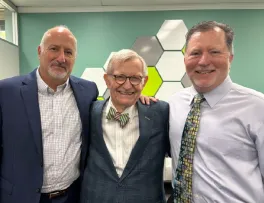
As noted above, the commitment to listening is shaping CHRR's own future. At our September 2 leadership meeting, we were fortunate to welcome E. Gordon Gee, two-time former president of The Ohio State University, and David Rosowsky, Senior Advisor to Arizona State University President Michael Crow, for a wide-ranging discussion about the future of higher education, stakeholder engagement, and organizational responsiveness. Their visit reinforced several themes that have become increasingly central to our thinking: the importance of understanding stakeholder perspectives before challenges become crises, the need for organizations to build trust through continuous engagement rather than episodic outreach, and the value of creating systems that help leaders recognize emerging signals from the communities they serve. These conversations align closely with CHRR's longstanding expertise in gathering and interpreting public opinion, while also challenging us to think more broadly about how our center can help institutions strengthen connections with their stakeholders in an increasingly complex environment.
Looking ahead, the CHRR Leadership Team focused on the possibilities that emerge when rigorous social science is paired with a genuine commitment to understanding people's lived experiences. Every survey response, interview, panel discussion, piece of administrative data, and community partnership represents an opportunity to detect important signals, deepen understanding, and inform more responsive decision-making. In a world often characterized by noise, polarization, and competing narratives, the simple act of listening carefully may be one of the most valuable contributions researchers and research organizations can make.
CHRR Team Member Celebrations
"Management is doing things right; leadership is doing the right things." -Peter Drucker
This month we are observing the work anniversaries of seven valued employees:
- Frank Bell, 26 years of service to CHRR.
- Sa Ho, 19 years of service to CHRR.
- Jenifer Hoffman, 7 years of service to CHRR.
- Alla Koneva, 28 years of service to CHRR.
- Craig Lee, 29 years of service to CHRR.
- Steve McClaskie, 41 years of service to CHRR.
- Thomasz Michalak, 20 years of service to CHRR.
That’s a total of 170 years of service to our center (and an average of over 24 years). Thank you for your commitment to the CHRR mission!
Things You Might Want to Know
OERC Work Featured in Ohio State’s OnCampus

A recent story from the John Glenn College of Public Affairs highlights how researchers at the Ohio Education Research Center (OERC) – our sister center located in the John Glenn College of Public Affairs – are helping the State of Ohio strengthen pathways back to employment for individuals who have lost their jobs. Through its evaluation of Ohio’s Reemployment Services and Eligibility Assessment (RESEA) program, OERC is working with state partners to better understand how workforce services can help unemployment insurance recipients navigate the often-complex transition back into the labor market. The research focuses on identifying what works, where barriers exist, and how support systems can be improved to connect Ohioans with meaningful employment opportunities.
This project, with leadership provided by OERC’s Tian Lou and Jessica Collura, underscores the value of rigorous social science research in informing public policy and improving program effectiveness. By combining data analysis with close collaboration among state agencies and workforce organizations, OERC is helping Ohio refine the services that support job seekers during periods of economic transition. The effort serves as another example of how Ohio State researchers are translating evidence into practical solutions that benefit individuals, communities, and the state as a whole.
Read the full article: Strengthening the Path Back to Work.
Gee, Rosowsky, and Gavazzi on WOSU’s All Sides
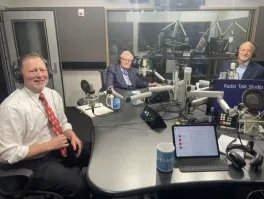
I joined my visiting colleagues Gordon Gee and David Rosowsky on Amy Juravich's WOSU Public Media’s All Sides program to discuss the future of American higher education. The conversation explored the challenges facing public universities, including rising costs, changing workforce expectations, the growth of micro-credentials, and the transformative impact of artificial intelligence. In fact, the entire show reflected many of the same themes driving CHRR's work, particularly the importance of understanding public perspectives and using evidence to inform institutional decision-making. The discussion also previewed the broader campus dialogue we participated in that evening, which focused on modernizing higher education and strengthening its relevance in a rapidly changing society.
Listen to How can academic leaders position higher education for the future? on WOSU.
Panel Discussion on the New Land-Grant Compact
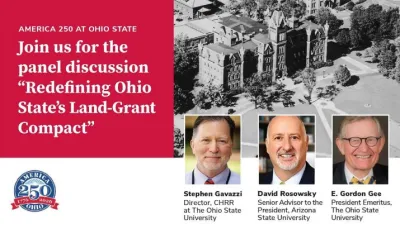
I also joined Drs. Gee and Rosowsky in a campus conversation exploring a timely question: What should a modern land-grant university look like as the nation approaches its 250th anniversary? The discussion was sponsored by the America 250 at Ohio State Committee (thank you to History Professor Scott Levi and Provost Trevor Brown for the support and the introductory remarks!) and was moderated adroitly by Assistant Vice Provost for Outreach and Engagement’s Nicole Nieto. Among other topics, the panel conversation focused on the enduring importance of land-grant institutions in expanding educational opportunity, driving economic development, advancing research, and strengthening communities, while also considering how universities must evolve to meet the needs and expectations of the public they serve today. A central theme of the conversation was public trust in higher education. Drawing on recent survey data, the three of us highlighted the distinction between public confidence in universities' educational mission and lower levels of trust regarding universities' broader societal role. In turn, we argued that the future success of land-grant institutions will depend not on better marketing, but on deeper engagement with communities and a renewed commitment to listening to public concerns.
Watch Redefining Ohio State’s Land Grant Compact on YouTube.
Read the detailed article, What does a modern land-grant university look like?, covered by Ohio State News.
Taken together, the many conversations covered in this newsletter underscore a theme that runs throughout CHRR's current work: organizations perform best when they create meaningful opportunities to listen, learn, and respond to the people they serve.